A medical emergency situation rarely unfolds in a tidy, book method. Someone collapses on Hastings Street, a child is pulled from the water off Noosa Main Beach, an officemates goes pale and unresponsive at a task website in Noosaville. In those first minutes, confidence deserves as much as devices. Individuals who have actually done a combined emergency treatment and CPR course in Noosa tend to move quicker, speak more clearly, and make much better choices when it matters most.
I have seen the difference. In groups where individuals train CPR and broader first aid together, individuals entrust a more practical sense of what emergencies seem like, not just what they appear like in a manual. That mix is what turns a certificate into useful capability.

This guide looks at how combined first aid and CPR training in Noosa works in the real life, what to look for in a provider, and how to keep your abilities sharp so you do not freeze when somebody needs you.
Why combine emergency treatment and CPR in Noosa?
On paper, you can treat first aid and CPR as different boxes to tick. In real emergency situations around Noosa, they come tangled together. A near‑drowning, a fall from a bike on the coastal track, an unexpected cardiac arrest at a coffee shop, all involve some mix of scene management, bleeding control, air passage care, and CPR.
When you do a combined emergency treatment and CPR course in Noosa, a number of things take place that do not happen as cleanly in stand‑alone training:
You discover to series your actions under pressure. It is one thing to understand the DRSABCD steps in isolation. It is another to walk into a simulated emergency and choose who to send for assistance, when to begin compressions, how to position a respiratory tract, and how to handle bystanders.
You comprehend context. For example, CPR course Noosa material reveals compressions and breaths. First aid training Noosa includes the layer of: the client may be bleeding, the ground might be hot bitumen, the danger might still be present, or the individual might have a medical bracelet. When both are taught together, those threads weave into a practical mental model.
You develop muscle memory across different scenarios. A good Noosa first aid course does not only drill cardiac arrest. It turns through choking, extreme bleeding, anaphylaxis from a bee sting, heat disease after sport at Noosa District sporting premises, and more. CPR skills are practiced inside those circumstances, not in isolation.
Employers and clubs prefer the combined technique. Regional workplaces, schools, browse clubs, and physical fitness studios often ask for a full emergency treatment certificate Noosa individuals can use for both compliance and real readiness. Combined first aid and CPR courses Noosa service providers deliver satisfy that need efficiently.
If time and budget are tight, you get more worth from one incorporated day of emergency treatment and CPR Noosa training than from separate, lightly linked sessions.
What combined first aid and CPR training really covers
Most nationally acknowledged emergency treatment courses in Noosa that include CPR follow a comparable spinal column of core abilities. The quality lies in how these aspects are taught and practiced, not simply that they appear on a list.
A thorough Noosa first aid training session that includes CPR typically covers:
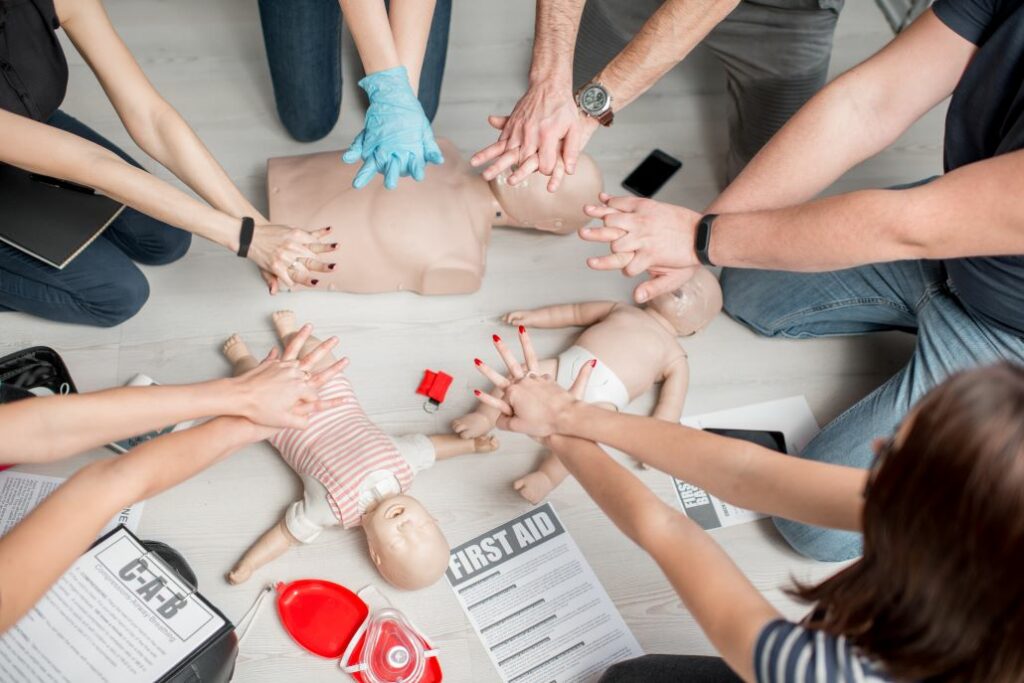
Cardiac arrest and CPR in detail. This is the heart of any great CPR training Noosa participants undertake. Anticipate duplicated practice of compressions and breaths on adult and kid manikins, sensible timing, and usage of an automated external defibrillator (AED). In much better courses, the fitness instructor cycles circumstances so you practice on the floor, in tight areas, and with a little background sound, closer to what takes place in public.
Choking and airway blockage. Noosa has a growing coffee shop and restaurant scene. Choking occurrences are not rare. You need to leave able to identify partial vs complete obstruction, and to perform back blows and chest thrusts securely on adults and kids. Good fitness instructors also walk you through infant strategies using a manikin, as this feels really different in the moment.
Breathing issues and anaphylaxis. In between tourism, outside sport, and regional flora, asthma and allergy flare‑ups prevail. Emergency treatment courses in Noosa usually cover using an asthma puffer with a spacer, action strategies, and auto‑injectors for anaphylaxis. The crucial skill here is acknowledging early indication, not just dealing with the obvious crisis.
Bleeding control and injuries. From glass cuts on the riverbank to bike spills on the Noosa Path Network, bleeding injuries are everyday events. A strong first aid course in Noosa shows how to apply pressure plasters correctly, improvise dressings if supplies are limited, and choose when bleeding is extreme enough to treat as life‑threatening.
Fractures, sprains, and spinal care. Surfing, skating, hiking, and deal with building and construction sites all bring a danger of falls. You must practice immobilising a limb, supporting a suspected fracture, and understanding when to avoid moving somebody at all.
Heat associated disease and environmental dangers. The Noosa environment is lovely however unforgiving for the unprepared. Courses that understand the local context cover dehydration, heat exhaustion, heat stroke, and bites or stings common in the area. Sometimes this area feels theoretical in a classroom, but people who work outdoors understand how quickly heat can dismantle someone.
Basic medical emergencies. Chest discomfort, stroke signs, diabetic emergency situations, and seizures demand clear thinking. A robust Noosa first aid course helps you identify red flags, handle the scene, and support the individual until paramedics arrive.
Across all of this, CPR Noosa material appears consistently as an alternative when a person stops breathing or loses flow. That repeating is precisely what develops confidence.
How Noosa's environment forms first aid priorities
First help training in Noosa is not rather the same as in a purely metropolitan, landlocked area. The landscape, environment, and lifestyle shape the incidents you are more likely to encounter.
Water plays a main function. Surfing, stand‑up paddle boarding, swimming, and boating imply a higher opportunity of near‑drownings, spinal injuries in surf, and cuts from rocks or boards. When you pick an emergency treatment course Noosa based, it helps to ask whether the trainer has experience with water situations and back precautions.
Heat and humidity influence whatever from dehydration to heat stroke. Events like the Noosa Triathlon, long summer walkings in Noosa National Park, or all‑day work outdoors push the body hard. A realistic Noosa emergency treatment training service provider will not gloss over heat illness as a theoretical danger. They will speak about early signs, such as subtle confusion or cramps, that show up well before collapse.
Tourism and crowds bring their own difficulties. Hectic cafés, markets, and beaches mean more spectators, more possible assistants, and often more chaos. Throughout an excellent CPR course Noosa individuals practice giving clear directions to somebody else to call Triple Absolutely no, get an AED, or handle crowd pressure.
Distance from specialist care can matter too. While emergency services in Noosa are capable and responsive, you might be in a national park track, on a boat, or on a rural property when something fails. The time between event and ambulance arrival might stretch. That space is where first aid and CPR Noosa abilities are most important. High quality training prepares you to manage a patient for more than a couple of minutes.
When your fitness instructor comprehends Noosa, the scenarios feel familiar, not generic. That makes it easier to retain and remember what you learn.
What a strong training day feels like
People sometimes walk into a Noosa first aid course expecting a dry compliance session. The much better experiences feel closer to a workshop where you get your hands filthy, ask questions, and come away a little exhausted however sure of yourself.
On a common combined emergency treatment and CPR course in Noosa, expect an early start. After a quick orientation, an excellent trainer gets everybody practicing CPR within the very first hour. They demonstrate, then you copy, then they remedy. It is normal for grownups to find the depth and rate of compressions physically tiring. That is partially the point. You must leave knowing what 2 minutes of quality CPR really feels like, not simply how it looks.
Later in the day, circumstances become more complicated. You might work in pairs to respond to an unconscious person in a coffee shop setting, a casualty on the ground after a fall from a ladder, or a kid with suspected anaphylaxis after a treat. Trainers who have actually worked in the field do not keep everything neat. They introduce half‑heard info, altering patient conditions, and minor distractions so you must decide what matters most.
Discussion matters as much as drills. Individuals share stories about a real heart attack at a health club, a passing out episode at school pick‑up, or a serious asthma attack on a treking track. Those stories anchor the book content in lived experience. Over the day, you start to hear patterns: almost everyone who has been in an emergency states their first clear idea was either "I am thankful I did that course" or "I want I had actually done that course more recently."
Testing at the end of a Noosa first aid course should seem like verification, not a surprise exam. If a supplier has kept you engaged throughout, the last assessments simply offer you an opportunity to prove to yourself what you can do.
Choosing the right first aid and CPR course in Noosa
Not all companies teach to the same requirement, even if the certificates look similar. When you pick amongst Noosa first aid courses, a little scrutiny goes a long way.
Here is a basic choice checklist you can utilize when comparing choices such as Emergency treatment Pro Noosa and other Noosa emergency treatment training organisations:
- Is the course nationally identified and present to the latest guidelines for first aid and CPR? How much of the day is hands‑on practice compared to theory or video? What is the fitness instructor's real‑world experience in emergency situations, and do they know the Noosa context? Are group sizes little enough that everybody gets specific feedback on CPR technique? Does the schedule and place match you, whether you live in your area or are operating in Noosa temporarily?
Do not be afraid to ask direct concerns before booking. Ask how long the useful CPR element runs, the number of manikins are readily available per group, and whether evaluation can be duplicated if nerves obstruct the very first time. The method a company responses those questions tells you almost as much as their website.
If you operate in a high‑risk environment, such as building, fitness, childcare, or hospitality near the water, consider whether the Noosa emergency treatment course consists of circumstances customized to those risks. Some service providers want to adjust examples to match your workplace, specifically for group bookings.
What you really acquire from an emergency treatment certificate Noosa
Some people deal with a first aid certificate Noosa companies need as a box to tick, then forget it. The paper itself is only evidence that you have met a standard on one day. The genuine gain lies in what modifications in your head and hands.
You develop a structured method of thinking in emergency situations. Rather of a blur of panic, you have a mental script: check for threat, respond to the person, send out for aid, open the air passage, check for breathing, begin CPR if required. That structure leaves less space for helplessness.
You get used to seeing an unresponsive body as a problem you can work on, not a taboo item. In early courses, I viewed people think twice to touch a manikin, let alone a stranger. By the end of the day, they roll "clients" onto their side, tilt chins, pinch noses, and start compressions almost automatically.
Your sense of duty expands. After emergency treatment training in Noosa, many people report that they feel less like passive witnesses in crowded locations. They notice escape routes, AED cabinets at shopping center, and prospective dangers before they end up being incidents.
On a more useful level, you become more employable. Many roles throughout Noosa, from trip guiding and hospitality to education and entertainment, list an existing emergency treatment and CPR certificate as vital or extremely desirable. Employers like understanding somebody on website can manage a crisis while waiting on emergency services.
Perhaps most importantly, your family and friends acquire a quiet benefit. If something fails at home, you are no longer relying simply on ambulance reaction times. You can start care in those important first minutes.
The function of refresher training and CPR updates
Skills decay. That is not a character defect, it is how human memory works. CPR courses Noosa participants total feel crisp and clear on the day. A year later, information begin to slip: compression depth, the precise ratio of compressions to breaths, the series of actions for an AED.
For that factor, the majority of organisations motivate or need a CPR refresher course Noosa based every 12 months, even when the more comprehensive emergency treatment certificate technically stays valid for longer. There are sound factors for this pattern.
CPR guidelines develop as brand-new research study emerges. For example, recommendations around compression rate, emphasis on high‑quality compressions over best breaths, and AED use timing have all moved in time. A fast CPR refresher course Noosa trainers deliver brings you approximately date without the requirement to retake the entire emergency treatment qualification.
Refresher sessions are likewise a possibility to recalibrate your hands. Lots of people discover they had actually begun compressing too shallowly or slowly, based on defective memory. It is far much better to discover that out on a manikin than on a real person.
If your life or work puts you in routine contact with high‑risk environments, treat annual CPR Noosa refreshers as non‑negotiable. For others, it is still smart. Emergencies are uncommon up until they are not. You do not want your only CPR practice to be from numerous years ago.
Preparing yourself before the course day
You do not need medical understanding to start a first aid course in Noosa. Service providers design training around the presumption that people get here as novices. That said, you can make the most of your day with some light preparation.
Read the pre‑course material if it is supplied, however do not attempt to memorise whatever. Concentrate on getting a basic sense of the topics, not the great information. On the day, wear comfortable clothes that permits you to kneel on the floor and move easily. CPR practice includes leaning over manikins and often working on hard surface areas, so choose accordingly.
If you have knee or back concerns, tell the trainer early. A great fitness instructor will use options so you can demonstrate CPR efficiently without causing yourself harm. They might utilize tables, chairs, or adjusted positions, as long as you still reveal right technique.
Think ahead about scenarios you truly worry about in Noosa life. Perhaps you are nervous about a child choking in the house, a moms and dad with a heart disease, or a colleague with extreme allergic reactions. Share those issues during the course. Fitness instructors can typically tailor examples, or invest extra time on abilities that matter most to you.
How combined training modifications your reaction on the day
The real test of any Noosa emergency treatment course arrives when you hear a shout in a café, see someone collapse on the beach, or observe a kid turning blue in a playground. That is when integrated emergency treatment and CPR training pays off.
People who have only done a CPR course sometimes think twice when the emergency situation consists of blood, damaged glass, or crowd pressure. They know how to compress a clean, unmoving chest in a quiet room, but not how to take control of a chaotic scene. By contrast, someone trained in first aid and CPR Noosa based, where realistic scenarios are utilized, has actually already rehearsed that turmoil in smaller sized, much safer doses.
You are more likely to:
Speak up early and clearly. Instead of waiting on somebody "more certified", you look for reaction and breathing, then designate tasks calmly: "You, call Triple Absolutely no. You, find an AED. I am starting CPR."
Adapt to context. If the person collapsed on hot bitumen, you might rapidly slide something under them or move them a brief range if safe, to secure their skin while you work. If they are wet from the ocean, you know how to manage that around an AED.
Stick with the individual. CPR is effort, particularly in Noosa's heat. Training prepares you to switch out with another onlooker, count aloud to preserve rhythm, and keep going up until assistance takes control of, rather than stopping from fatigue or uncertainty.
It is not about being fearless. Many people feel scared during their very first real emergency. The distinction is that training provides you something to fall back on besides fear.
Bringing all of it together for Noosa locals and visitors
Noosa's beauty conceals real dangers: strong surf, hot pavements, remote strolling tracks, and hectic traveler spots where an unexpected emergency situation can easily draw a crowd however not always knowledgeable assistance. Emergency treatment course Noosa alternatives that integrate CPR and larger first aid skills give both residents and visitors a useful method to prepare.
Whether you choose Emergency treatment Pro Noosa or another reputable company, aim for training that feels grounded in Noosa life, not generic slides copied from a city class. Try to find lots of hands‑on CPR, sensible scenarios, and fitness instructors who can speak plainly about what emergency situations are really like, not simply how they check out in a manual.
A single day of Noosa emergency treatment training will not turn you into a paramedic. It will, nevertheless, turn you from a bystander into a capable first responder, able to bridge the important minutes in between collapse and professional care. In a town where the next emergency situation may unfold in a browse break, a café, a building site, or a holiday rental, that confidence is not a luxury. It is part of being an accountable member of the community.
Nationally Recognised First Aid Courses Noosa Locals Trust! First Aid Pro is one of Noosa’s leading providers of accredited CPR and first aid courses. Established in 2010, our nationally registered training organisation (RTO) has equipped over 3 million Australians with essential life-saving skills through our experienced team of 110+ expert trainers. Conveniently servicing Noosa and the Sunshine Coast region, we provide top-quality, nationally accredited CPR and first aid training sessions tailored to your needs, whether for workplace requirements, career advancement, or personal safety. From childcare-specific first aid training to advanced first aid and resuscitation courses, we’ve got you covered. First Aid Pro – First Aid Course Noosa Noosa Conference Centre 73 Hilton Terrace Noosaville QLD 4566 Australia Phone: (08) 7120 2570 Secure your Noosa first aid course or CPR training with us and build the confidence to handle emergencies with a trusted Noosa first aid provider. Take the first step towards becoming a skilled and capable first aider with First Aid Pro Noosa today.
Location & Venue Details Our First Aid Pro Noosa courses are held at Noosa Conference Centre, 73 Hilton Terrace, Noosaville QLD 4566, conveniently located in the heart of Noosaville. This modern and well-equipped venue provides a professional and comfortable training environment ideal for first aid, CPR, and childcare first aid courses. It’s the perfect location for participants travelling from Noosaville, Noosa Heads, Tewantin, Sunrise Beach, and surrounding Sunshine Coast suburbs. Situated close to the Noosa River, the venue is near popular local landmarks including Noosa Marina, Noosa Civic Shopping Centre, Noosa National Park, and Hastings Street. The surrounding area offers a variety of cafés, restaurants, and takeaway outlets—perfect for enjoying lunch or coffee before or after your course. With easy access to Noosa Main Beach and nearby riverside parks, it’s also a great place to relax before or after your training. Training is conducted in spacious, air-conditioned rooms within Noosa Conference Centre, equipped with high-quality first aid and CPR training equipment and comfortable seating. The venue provides convenient onsite parking and nearby street parking for participants attending the course. The site is fully accessible, offering step-free entry and accessible restroom facilities, ensuring a smooth and inclusive training experience for all learners.